About the music
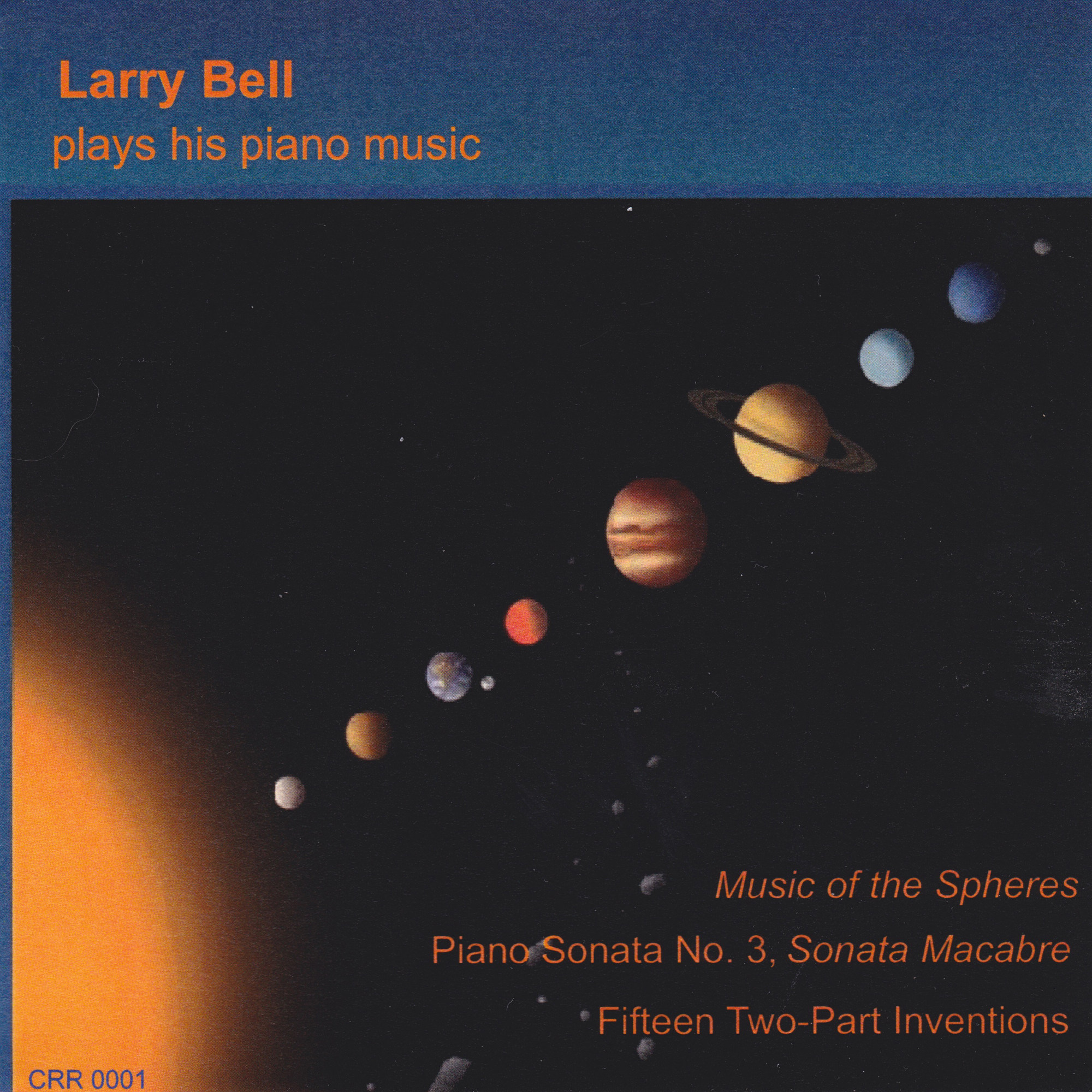
Music of the Spheres, op. 82
The sculptural mobiles of Alexander Calder, which I saw at the San Francisco Museum of Modern Art in March 2006, inspired this work for solo piano. Calder’s preoccupation with the planetary orbits and his unique sense of motion and balance gave me the idea of doing something similar in a musical medium.
While this work has no direct connection to Holst’s “Planets,” indirect references to the characters of the Greco-Roman gods can be heard. Jupiter, for instance, begins with a lightening bolt, Mars has a certain militaristic rhythm, and Mercury is quite rapid and fanciful.
Unlike Pythagoras, who was preoccupied by the relationship between harmonic intervals and the proportional distance of the other planets to the earth, my main interest was to derive the rhythmic proportions of the music from the planets’ relative distance to the sun. One underlying macro-speed connects all the movements with their respective proportions. That fundamental speed is expressed in time as dotted half note equals 33: In both Mars and Earth the quarter note equals 99, which means the dotted half equals 33. Uranus is scored at dotted quarter equals 66 (so the dotted half equals 33). In Neptune the dotted quarter note equals 44, in Pluto the quarter equals 44 (both two-thirds of 66; a 2:3 ratio); and in Jupiter that quarter is doubled to equal 88. Saturn’s quarter equals 66 (twice 33), while for Venus and Mercury it equals 132 (twice as fast as 66, or four times 33).
Earth here is considered to have a 1:1 relationship to the sun. The uniqueness of the Earth is characterized by unison and octave textures. Mercury, the shortest distance, has a relationship of about .4 of that of the Earth, its relative distance closer to the sun. Its relationship in the music is expressed as the polyrhythm 5:2–another way of expressing .4, that is, two-fifths of a beat, or five sounds against two beats. Pluto is approximately 39.5 times further from the sun than the earth, and this is expressed musically in chords whose durations are 39.5 sixteenth notes. In Venus the proportion 5:4, which expresses its .8 of the distance of the Earth to the sun.
Uranus is nineteen times the distance from the Earth to the sun, therefore the chords in its movement occur every nineteen sixteenth notes. Similarly, Pluto has a chord every 39 sixteenth notes. Jupiter, which is 5.2 times the Earth’s distance from the sun, is first rounded down to five and written as groups of phrases with five beats. Mars, at 1.5 the distance to the sun, lends itself nicely to 2:3, two beats sound against three beats. Neptune, on the other hand, is thirty times our distance from the sun, and therefore is broken into 5 times 6, or six five-beat phrases = 30. The swirling, circular figures of Saturn represent its rings. Saturn is 9.5 times the Earth’s distance from the sun, which I rounded down to 9:2 to represent nine and a half eighths.
In order to present nine separate pieces in a dramatic sequence, I arranged them so that the increasingly further away orbits alternate with the increasingly closer: Jupiter, Saturn, Uranus, Neptune, and Pluto become slower and alternate with Mars, Earth, Venus, and Mercury, which become faster. Thus the work ends with fastest piece, Mercury, followed by the slowest, Pluto. In addition, the first piece, Jupiter, functions somewhat as an overture that foreshadows each of the other movements. Just after I had written and learned these pieces did astronomers decide to renumber the planets and eliminate Pluto!
Piano Sonata No. 3, for solo piano, op. 83
Sonata Macabre
My Third Piano Sonata was written in June of 2006 and grew out of a desire to understand the musical language of one of my teachers, Roger Sessions. After a thorough analysis of the Sessions nine symphonies, I began to notice a consistent (although unorthodox and unsystematic) approach to the choice of pitches. Most notable, however, was the absence of any techniques associated with dodecaphony or serialism.
Instead, I noticed a distinct preference for half-step fluctuations between scales of the same type (such as whole tone and octatonic scales). Furthermore, these scales were embellished with “non-harmonic” tones that lay outside of these collections. Although these groupings were clearly not tonal, they also seemed to avoid any type of system. The pitches were chosen rather freely, but always in relation to a principal motive or theme.
My own sonata follows the classical scheme: first movement, sonata form with three expositions (a form dear to Sessions and derived from Beethoven); an elegiac slow movement; a third-movement minuet and trio; and a frenetic and somewhat sardonic finale. The overall character of the music shows the influence of Sessions, as well, in its preoccupation with a kind of black comedy; thus the subtitle Sonata Macabre. In addition, while composing the sonata, I learned of the death of the great Hungarian composer, György Ligeti, hence the dedication at the head of the second movement.
I recorded my first Piano Sonata on “New American Romantics” in 1996 on North/South Recordings (N/SR 1007) and my Piano Sonata No. 2 (Tâla) on “Piano Music of Larry Bell,” Albany Records (Troy 828). I gave the world premieres of both the Music of the Spheres and the Third Sonata October 15, 2006, at New England Conservatory’s Jordan Hall.
Fifteen Two-Part Inventions, op. 96
Like J. S. Bach’s fifteen two-part inventions, this set of inventions both follows his same pattern of keys and is designed for didactic purposes. The titles, such as Invention no. 1 in C major, are used only in a metaphorical sense, since none of these pieces is, strictly speaking, tonal. No. 1 could be more accurately described as pandiatonic, no. 2 uses a blues scale, no. 3 is in the dorian mode, etc. The piano teacher might consider assigning these pieces–either instead of or in addition to the Bach–to promote a greater understanding of musical structure and to teach the fundamentals of sound production and phrasing.
In terms of musical structure, many of the same kinds of techniques and contrapuntal procedures one finds in Bach’s inventions are here, too. Most of the subjects are imitated conventionally at the octave; the exceptions are nos. 4 and 8 that use imitation at the fifth, while no. 10 imitates at the minor seventh. The presentation of the subject as an accompanying pattern is an unusual feature: It can be seen in nos. 5, 12, and 13. Subjects are generally first introduced unaccompanied; exceptions are found in nos. 7 and 11, which are based on the folk songs, respectively Wayfaring Stranger and Which Side Are You On?
In addition, the subject often appears in augmentation (no. 1, ms. 15-20), melodic inversion (no. 2, ms. 17-20), modulatory sequences to closely related keys or modes (all Inventions), subject in stretto (no. 3 ms. 15-20), strict canon at the fifth (no. 4, ms. 1-24), cross-accented phrasing and hemiola (no. 8), double counterpoint at the octave (no. 6, ms. 32-35 and in virtually all of the others), and double counterpoint at the twelfth (no. 13, ms. 15-18). Finally, the Invention no. 14 in Bb major comically parodies Bach’s Invention no. 14 in the same key.
For the most part, each invention is written in two parts. As in Bach, the exceptions occur when added extra voices fortify final cadences. Invention no. 12 also begins with a multi-voiced introduction brought back at its coda in mirror inversion. Although pedal markings appear only in no. 2, it is understood that the pianist will use pedal melodically (where slurs are indicated) and harmonically (at changes of root succession). Accents should be pedaled (as in no. 15) to achieve a better quality of sound.
Because these pieces are written in a contemporary vernacular idiom, I hope that this music may be more stylistically accessible than music written in the eighteenth century. These Inventions were composed for students of all ages, especially those new to the piano but familiar with popular music. I gave the word premiere at the Berklee College of Music October 9, 2008.
–Liner notes by Larry Bell