Archives

Twenty-Four Preludes and Fugues

Twenty-Four Preludes and Fugues

Stream/Buy
Liner notes

Influenced by Bach’s magisterial Well-Tempered Clavier, Book I, composer Larry Bell’s 24 Preludes and Fugues actually began as another work and it wasn’t until he wrote a Prelude and Fugue in F Major for piano that he decided to complete the remaining preludes and fugues. Bell wrote the fugues first with their preludes being fashioned out of motives derived from the fugue’s subject. Each is self-contained and designed to culminate in one large narrative that the listener may experience without knowing any of the specialized techniques of its composition. Larry Bell is an award-winning composer with the Rome Prize and the Charles Ives Award from the American Academy of Arts and Letters to his credit, among many orders. His music has been commissioned and performed by a distinguished array of performers, chamber ensembles, and orchestras. The 24 Preludes and Fugues are performed by four outstanding pianists — Carmen Rodríguez-Peralta, Maja Tremiszewska, Jennifer Elowsky-Fox, and John McDonald — all of whom enjoy noted careers as recitalists and chamber musicians.

On an Overgrown Path

On an Overgrown Path

Description

Featuring Piano Sonata No. 5 “A Landscape of Small Ruins”
Jennifer Elowsky-Fox-pianist

Date
2024
Stream/Buy
Liner notes

ON AN OVERGROWN PATH from pianist Jennifer Elowsky-Fox features music by composers Leoš Janáček and Larry Thomas Bell. Janáček gives the album its title piece, a programmatic work that evokes the composer’s memories from early 20th century Moravia. The piano cycle, performed with masterful sensitivity by Elowsky-Fox, blends the eastern and western cultural influences of the region. Based on hymn tunes included in Bell’s A Hymnbook for Congregational Singing, op. 169, Bell’s Piano Sonata No. 5, A Landscape of Small Ruins, op. 166, was composed in 2020 specifically for Elowsky-Fox. Her performances have been described in print as “buoyant”, “fun,” and “gorgeous in all respects,” all sentiments that resonate in this Navona Records release.

THOUGHTS & PRAYERS: MUSIC BY LARRY BELL

Thoughts & Prayers: Music by Larry Bell

Description

Larry Bell, Jennifer Rachel Webb, Sam Ou, Deborah Nemko, David Wallace, Jennifer Rachael Webb

Program notes

Thoughts and Prayers is an album of tributes that draw upon composer Larry Bell’s personal, social, national, and international awareness. The music is drawn from a solemn personal conviction and desire to preserve the lives of others in our memory. It is also a simple act of bearing witness to events that may be all too soon forgotten or too painful to contemplate. Bell offers four works for solo piano interspersed with two works for soprano, cello/viola, and piano. Award-winning composer Larry Bell’s music has been commissioned and performed by a distinguished array of musicians, ensembles, and orchestras. He has taught at The Juilliard School, the Boston Conservatory, New England Conservatory, and the Berklee College of Music. He is joined on this recording by mezzo-soprano Jennifer Webb, cellist Sam Ou, pianist Deborah Nemko, and violist David Wallace.

Reviews

A listen that takes into account Larry Bell’s personal, social, national, and international awareness, the esteemed composer brings in help on vocals and strings for these songs that preserve the memory of those lost, and the events that we should never forget occurred, despite how painful they may have been. “Third Elegy: In Memory Of K.E.O “starts the listen with a solo piano piece from Bell, where his cautious and warm key patterns emit much beauty, and “Halcyon Song” follows with Jennifer Richard Webb’s stunning mezzo-soprano and Sam Ou’s elegant cello helping make for a stirring climate. Further along, “Nine Variations We Shall Overcome”places Deborah Nemko on piano for the highly melodic and meticulous delivery, while “Prayers Book I”pays tribute to Travon Martin, Michael Brown, Eric Garner and many others who lost their lives due to very unjust circumstances, as Bell’s lone piano alternates between ominous rumbling, dense moments and swift mysteriousness. Near the end, “Domenica a Filicudi”showcases Webb’s flawless pipes amid David Wallace’s intimate viola and Bell’s mature keys for the album’s best, and “A Postcard From Ukraine”exits the listen with Bell’s single piano that’s full of tuneful, rich playing. Bell has an impressive resume that includes teaching at the Juilliard School, the Boston Conservatory, New England Conservatory, and the Berklee College of Music, and this exceptional reflection of the often difficult times we live in is quite articulate.

– TAKE EFFECT REVIEWS

Fincent Persichetti Piano Miniatures

Vincent Persichetti: Piano Miniatures

Vincent Persichetti: Piano Minatures

Description

World premiere recordings of piano music by Vincent Persichetti recorded by pianist Larry Bell. Available soon as a download only from Arabesque Recordings.

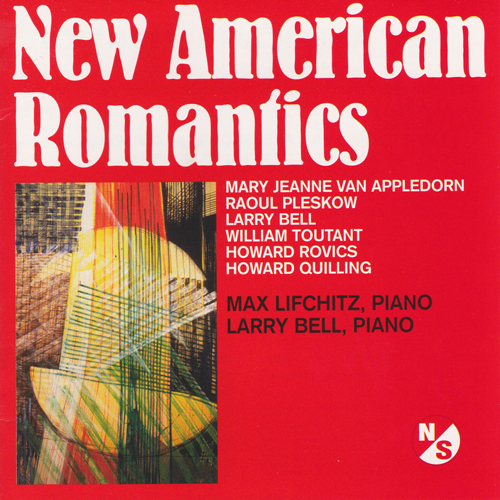
New American Romantics Album Cover

New American Romantics

New American Romantics

Description

(N/S R 1007)

Larry Bell Piano Sonata
Larry Bell, piano

Program notes

The Piano Sonata is a virtuosic and exciting four-movement composition. While each of the movements is self-contained and unique, each is also fully related to the remaining three. The composer compares them to “four different people with the same genes.”Written during the summer of 1990, each movement is dedicated to a pianist who has performed Bell’s music. These are: Penelope Roskell, Wu Han, Michael Dewart and Carmen Rodríquez-Peralta. The music was designed to be idiomatic for the piano. Traces of a single-theme sonata form are easily detected in he first movement. The meditative, song-like second movement consists of a simple theme followed by a few variations. The third movement is a jazzy parody of the seriousness found in the opening movement. The rhythmic excitement of the concluding fourth movement gives the impression of an exotic toccata inspired by an imaginary South American dance.

Sample Pieces
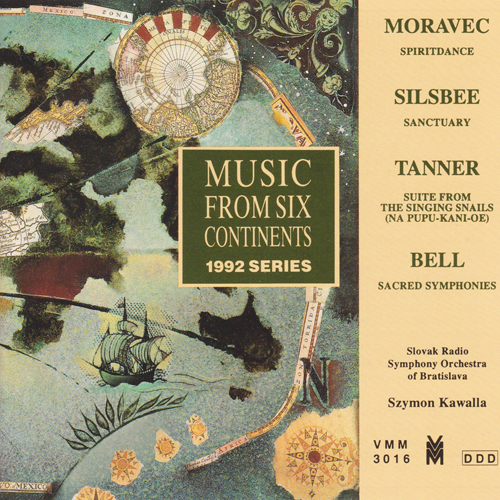
Music from Six Continents 1992 Album Cover

Music from Six Continents 1992 Series

Music from Six Continents 1992 Series

Description

(VMM 3016)

Larry Bell Sacred Symphonies
I. Soulfully 5:25
II. Spirited 6:23
III. Powerfully 5:48
IV. Transcendently 6:26

Program notes

Music from Six Continents 1992 Series(#3037)
Larry Bell – Sacred Symphonies

Sacred Symphonies was commissioned by and is dedicated to the composer’s Italian friend, Verio Piroddi. Signor Piroddi had requested a religious work; therefore, the composer drew from his own religious experience as a Southerner whose family was raised in the Pentecostal Holiness church. The title Sacred Symphonies is an Anglicization of the titles of the Schutz and Gabrieli works. To prepare for the orchestral work, Bell composed Four Sacred Songs for Soprano and Piano. Each song is a setting of a familiar hymn tune text; however, the music itself is new and makes no reference to the original hymn tunes. The four movements of the

Sacred Symphonies correspond, Mahler-like, to the four songs: “There Is a Fountain,” “Take the Name of Jesus with You,” “Stand Up, Stand Up for Jesus,” and “Spirit of God Descend upon My Heart.” Each represents a religious state: atonement, evangelism, suffering, and humility.

Sacred Symphonies has a double texture throughout: the symphonic development of the themes of the songs coexists with a slow-moving version of the songs in a distant tonality. The sequence of movements suggests a sense of spiritual progress – a coming to terms with the conflicts of the past. The quasi-autobiographical subject matter and the combination of vernacular and cultivated techniques creates in Bell’s Sacred Symphonies the distinctive color of indigenous American music – music in the tradition and spirit of Ives and Copland.

Sacred Symphonies was completed in the summer of 1985 while Bell was a resident composer at the Rockefeller Foundation’s Conference and Study Center in Bellagio, Italy. The work received its first performance in February 1987, with the Seattle Symphony, conducted by Christopher Kendall.

Andrea Olmstead

Reviews

Sacred Symphonies, (1985) by erstwhile North Carolina-native and Juilliard-graduate Larry Bell (b. 1952), is of more serious intent. In somewhat Ivesian fashion, the four movements of Sacred Symphonies are transformations of hymnlike music, settings originally created by Bell for his Four Sacred Songs . The difference between Bell and Ives is that the tunes themselves are his own, although clearly his music draws on the tradition of vernacular church music. The symphonic expansion of these tunes involves the parallel presentation of the hymn tune and its development along with a much slower version of the tune (although this isn’t always clear to me). This divided exposition amplifies the resemblance to Ives, particularly in the third movement. A few clichés—the cadence of the second movement, for example—slightly mar the appeal, but overall this is a substantive and moving work.

Performance and recording are not at the highest level, but are sufficient, I think, to indicate the potential of these works, which seems to be the point of the Music from Six Continents series. Partly due to the faulty, too-eclectic program, this will be of less-than-average interest except to the very curious, but I think the Silsbee and Bell pieces merit further exposure. This disc is available from CDemusic.com, an interesting distributor of new music recordings.

Robert Kirzinger-Fanfare Magazine

This article originally appeared in Issue 28:5 (May/June 2005) of Fanfare Magazine.

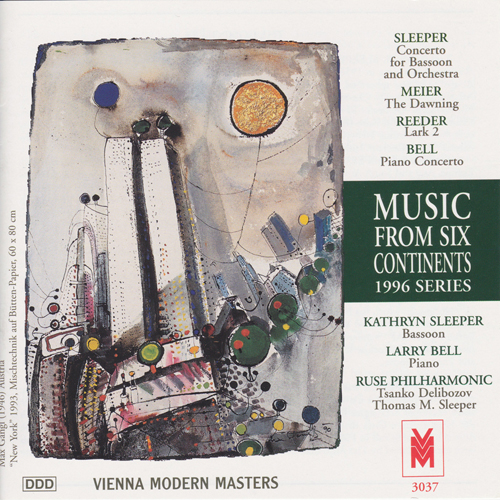
Music from Six Continents 1996 Album Cover

Music from Six Continents 1996 Series

Music from Six Continents 1996 Series

Description

(VMM 3037)

Larry Bell – Piano Concerto
Ruse Philharmonic
Tsanko Delibozov, conductor
Larry Bell, piano

Larry Bell Piano Concerto
I. Lyrical and Magestic 9:02
II. Blues Theme with Variations 7:26
III.. Dancelike and Driving 5:24

Program notes

Music from Six Continents 1996 Series(#3037)
Larry Bell – Piano Concerto

Piano Concerto was commissioned by Gerard Schwarz for Music Today and the Seattle Symphony Chamber Players. Dedicated tot he conductor, it was premiered by him in New York in 1989 with the composer as soloist. The work received its European premiere in Bulgaria in June 1996 with the Ruse Philharmonic Orchestra, Tsanko Delibosov conducting and the composer as soloist.

Piano Concerto is in three movements of increasing tempo and brevity. The first, Lyrical and Majestic, contains two themes one for orchestra and one for the soloist. During a brief moment in the middle of the movement the orchestra shares the piano’s theme. The piano, however, grudgingly recognizes the orchestra’s theme in an ironic role reversal at the end of the movement.

The second movement, Blues Theme with Variations, is based on an original melody. The popular blues idiom permeates the set of classical variations. As in the first movement, a brief cadenza introduces a recapitulation of the main theme.

In Dancelike and Driving, the third movement’s rhythm is rock-influenced. Later the blues theme of the second movement reappears. As the concerto progresses, each movement gets faster and shorter and the concertato texture diminishes; the piano ultimately plays with the orchestra and not against it.

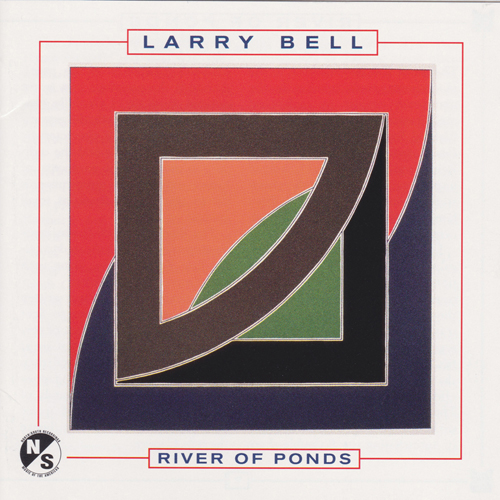
River of Ponds Album Cover

River of Ponds

River of Ponds (#1018)

Description

(N/S R 1018)
Larry Bell:
The Black Cat
Caprice
Fantasia on an Imaginary Hymn
River of Ponds

Featuring Eric Bartlett, cello
with Robert J. Lurtsema, narrator
Sarah Clarke, viola
Larry Bell, piano

Stream/Buy
Program notes

The Black Cat harkens back to the monodrama made popular in the nineteenth century by such Liszt melodramas as Der Traurige Monch. Richard Strauss’ later monodrama Enoch Arden, recorded by Claude Reins and Glenn Gould, helped inspire my adaptation of the ghost-story setting of Edgar Allan Poe’s familiar tale of murder and madness.
I augment the monodrama’s typical narrator-and-piano instrumentation to include a cello. The cello represents the cat; the piano portrays the man telling the story and also sets the climate for the individual scenes. The cello has its own leitmotifs, for example, the tritone glissando that mimics a “meow” similar to the effect found in Ravel’s animal opera. The music is based on the opening melody in G-sharp minor (frequently necessitating the F double-sharp scull-and-crossbones on the page). Although the narrator’s part is not notated musically, I carefully connected the words with the accompanying music. Poe’s characteristic blend of the horrible and the ordinary is not without moments of humor – after all, a grown man is driven crazy by an innocent small animal!

The Black Cat (1987) was commissioned by and is dedicated to cellist Eric Bartlett, who, along with the composer, is a cat lover.Caprice for solo cello was written in 1978 and is dedicated to Scot Williams. The piece consists of several basic character types that are at first presented separately and then later in combination. The juxtaposition of these cross-cut strands of music produces a kind of ironic counterpoint of characters; hence the title Caprice.The Fantasia on an Imaginary Hymn for cello and viola was commissioned by Joel Chronic for his 1983-84 six-concert series at Juilliard and the Library of Congress entitled “The Cello: A Twentieth-Century American Restropective.” The work was composed at the American Academy in Rome in 1983. The New York and Washington premieres were played by Krosnick and Samuel Rhodes in March 1984. Later the Fantasia was played on concerts of the Juilliard String Quartet. Eric Bartlett and Sarah Clarke gave the Fantasia its Boston and European premieres.

In an interview with Perry Goldstein, Krosnick says of this piece: “Larry Bell has organized his serial structures in diatonic ways – that is, with the same building blocks with which traditional tonal music is made. Rhythmically, however, and in terms of its polyphony, it is contemporary in its complexity and careful detailing. The two instruments in Larry’s piece often represent two different characters, juxtaposing different kinds of music simultaneously, much like in the Carter Sonata. And yet, the organization of the materials and the materials themselves clearly come from the emotional world of Larry Bell. The music is often lyrical, sweet, playful – quite American sounding, containing the lilt of Southern folk music.”River of Ponds was completed in 1986 at the American Academy in Rome and was commissioned by and dedicated to Joel Krosnick and Gilbert Kalish. The tile itself is drawn from a series of painting called “River of Ponds” by Frank Stella. Stella was the Painter-in-Residence at the AAR during my Rome Prize Fellowship (1982-83).

The underlying theme of Stella’s River of Ponds is a reflection upon his own childhood and the fishing trip he took with his father. The movement titles of River of Ponds -“Black Creek,” “Wyatt Earp’s Pond,” and “Silver Lake” – refer to my memories of childhood in North Carolina.

The first piece, “Black Creek,” is based on an original melody. This melody first occurs as a vague recollection from the past. The center of the movement contains a clear presentation of this theme as a vivid memory. The end of the movement dissolves as it began. G major and B major are contrasting tonal areas that grow out of the intervals of the theme itself.

“Wyatt Earp’s Pond'” is a nickname given to a fishing hole near where I grew up. This title has a humorous connotation and the movement could be thought of as a scherzo; a scherzo with two trios. In the trios the hymn tune “Softly and tenderly” is quoted.

The last movement, “Silver Lake,” is a double variation form. The first theme is similar to the old hymn tune “The Old Rugged Cross,” stated in a slow and somewhat grandiose manner. The second theme is drawn from the first movement; however here the theme is dance-like, driving, and usually grouped in rhythmic units of seven. The recurrence of both themes suggest a rondo finale.

Reviews

Bell Tones for Cello (CD review)

Larry Bell . River of Ponds [ The Black Cat. Caprice for Solo Cello. Fantasia on an Imaginary Hymn. River of Ponds ]. Eric Bartlett, Robert J. Lurtsema, Sarah Clarke, Larry Bell . North/South Recordings.

How else can one describe the mellow baritone of Boston radio personality Robert J. Lurtsema narrating The Black Cat by Edgar Allen Poe to Larry Bell’s lithesome cello/piano music (performed by Eric Bartlett and the composer) but as… Haunting?Bewitching? Sinister? Vivid? Dramatically appropriate? All of the above, and the frequent F-double-sharps on the page (skull and crossbones — ha! ha!) add to the effect. Lurtsema’s booming morning pro musica voice doesn’t hurt either (the narrator a composer himself with songs, a film score, chamber pieces, and a bassoon quartet adapted for Julia Child among his credits). But the line, “I buried an ax in her brain” certainly does. Ouch. But the music remains considerably less painful — quoth the reviewer: downright beautiful. Bell has a Southern tone to his writing, touching on American folk tunes and hymns, even quoting “The Old Rugged Cross” in the third movement of his River of Ponds , the title selection on this North/South recording. Throughout, Bartlett and Bell perform blazingly. And the solo cello Caprice and duet Fantasia on an Imaginary Hymn (where the cellist is nicely joined by violist Sarah Clarke) come off very fine as well.

Mark Alburger- 21st Century Music

Sample Pieces